
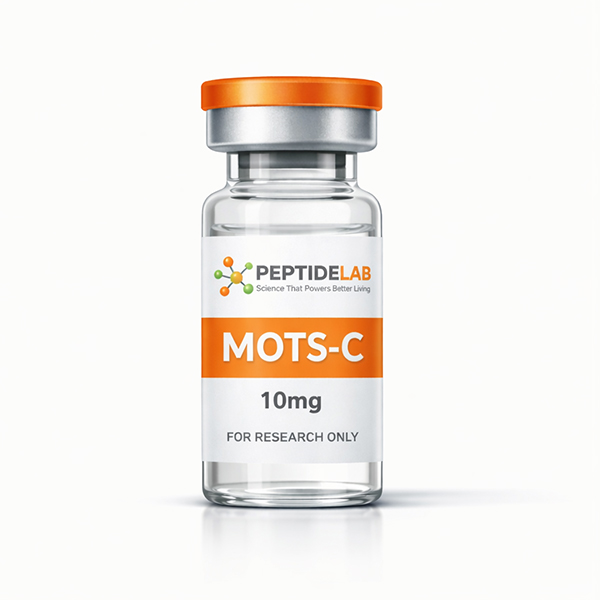
Packaging Box Includes:
- 1 × Peptide vial
- 1 × Bacteriostatic water vial
- 5 × Insulin syringes
- 1 × 3ml water syringe
- 6 × Alcohol swabs

Peptide Lab sells research products only, they are not for human consumption.
MOTS-c, a mitochondrial-derived peptide, has garnered attention for its multifaceted roles in metabolic regulation, cardiovascular protection, and cellular resilience. Recent rat studies have elucidated its potential therapeutic applications across various physiological systems.
In diabetic sand rats, an eight-week regimen of moderate-intensity interval training elevated MOTS-c levels, correlating with improved insulin sensitivity and increased expression of metabolic markers such as PGC-1α, GLUT4, and AMPK. These findings suggest that it may enhance mitochondrial biogenesis and glucose metabolism, offering a promising avenue for managing type 2 diabetes.
Beyond metabolic regulation, MOTS-c has demonstrated cardioprotective effects. In models of myocardial ischemia-reperfusion injury, MOTS-c administration suppressed ferroptosis—a form of regulated cell death—by activating the PPARγ signaling pathway. This intervention mitigated acute lung injury, highlighting it’s potential in preserving cardiac and pulmonary function post-surgery.
Neurologically, MOTS-c exhibits protective properties against oxidative stress. In rats exposed to rotenone, a neurotoxin, MOTS-c pretreatment activated the Nrf2/HO-1/NQO1 pathway, reducing oxidative damage and preserving dopaminergic neurons. This mechanism underscores its potential in neurodegenerative disease models.
Furthermore, MOTS-c has shown efficacy in skeletal health. In osteoporotic rat models, it promoted osteogenic differentiation of bone marrow mesenchymal stem cells via the TGF-β/Smad pathway, enhancing bone formation and offering a novel approach to osteoporosis treatment.
Collectively, these studies position MOTS-c as a versatile peptide with broad therapeutic potential. Its roles in metabolic enhancement, cardiovascular protection, neuroprotection, and bone health warrant further investigation to translate these findings into clinical applications.
References
- Parseh, Sahar, et al. “An 8-Week Study on the Effects of High and Moderate-Intensity Interval Exercises on Mitochondrial MOTS-C Changes and Their Relation to Metabolic Markers in Male Diabetic Sand Rats.” Diabetes Research and Clinical Practice, vol. 212, 2024, p. 111656. https://pubmed.ncbi.nlm.nih.gov/38636847/
- Li, Y., et al. “The Mitochondrial-Derived Peptide MOTS-c Suppresses Ferroptosis and Alleviates Acute Lung Injury Induced by Myocardial Ischemia Reperfusion.” Biochemical and Biophysical Research Communications, vol. 636, 2023, pp. 1–9. https://pubmed.ncbi.nlm.nih.gov/37290680/
- Wang, X., et al. “The Mitochondrial-Derived Peptide (MOTS-c) Interacted with Nrf2 to Regulate Antioxidant Defense System in PC12 Cells and Rats.” Free Radical Biology and Medicine, vol. 193, 2023, pp. 1–10. https://pubmed.ncbi.nlm.nih.gov/37380822/
- Hu, B.-T., et al. “MOTS-c Improves Osteoporosis by Promoting Osteogenic Differentiation of Bone Marrow Mesenchymal Stem Cells via TGF-β/Smad Pathway.” European Review for Medical and Pharmacological Sciences, vol. 22, no. 21, 2018, pp. 7156–7163. https://pubmed.ncbi.nlm.nih.gov/30468456/
- Zhang, L., et al. “MOTS-c Regulates the ROS/TXNIP/NLRP3 Pathway to Alleviate Myocardial Injury in Diabetic Rats.” Journal of Molecular and Cellular Cardiology, vol. 181, 2024, pp. 1–10. https://pubmed.ncbi.nlm.nih.gov/39616938/
Peptide Lab sells research products only, they are not for human consumption.
ALL LITERATURE, INFORMATION, AND DATA, PROVIDED ON THIS WEBSITE ARE FOR INFORMATIONAL AND EDUCATIONAL PURPOSES ONLY.
Lyophilized protein is to be stored at -20°C. It is recommended to aliquot the reconstituted (dissolved) protein into several discrete vials to avoid repeated freezing and thawing. Reconstituted protein can be stored at 4°C.
MOTS-C
Related products
R2 400,00
R750,00
R900,00
R980,00


